Liberal Arts & Sciences: Admissions open for 2026–27. Explore double major and minor combinations.
AU
People · Ideas · Perspectives · Building #4

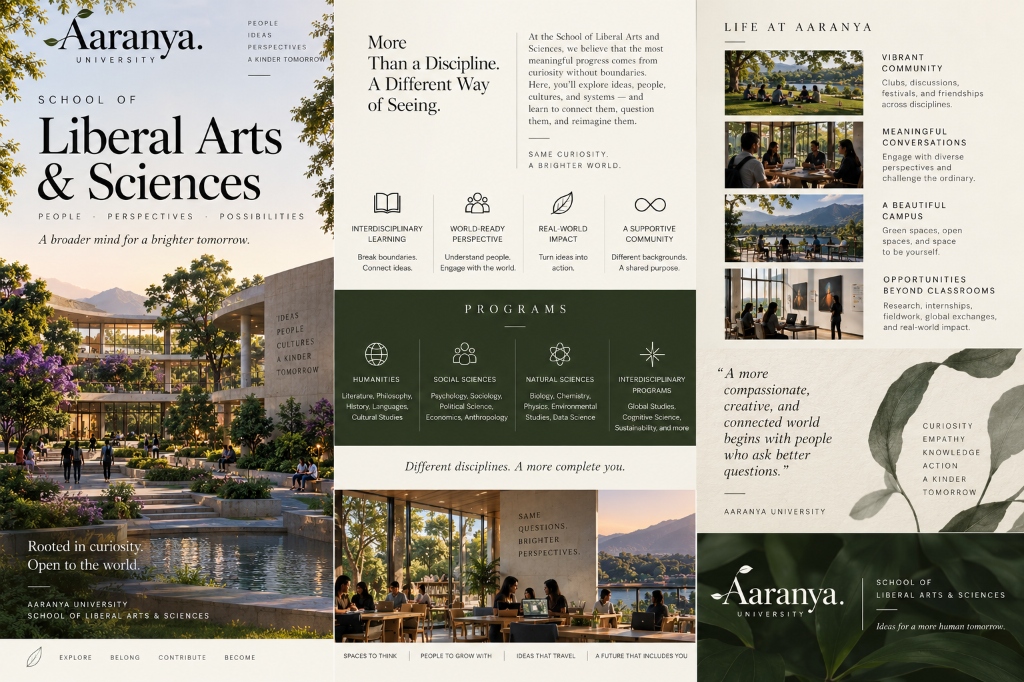
School of Liberal Arts & Sciences

People · Perspectives · Possibilities — A broader mind for a brighter tomorrow.

Apply for Liberal Arts View Full Curriculum
Rooted in Curiosity. Open to the World.

More Than a Discipline. A Different Way of Seeing.

At the School of Liberal Arts and Sciences, we believe that the most meaningful progress comes from curiosity without boundaries. Here, you'll explore ideas, people, cultures, and systems — and learn to connect them, question them, and reimagine them.

“Different disciplines. A more complete you.”

The Four Core Pillars:

  • Interdisciplinary Learning: Break boundaries. Connect ideas across natural and social domains.
  • World-Ready Perspective: Understand people. Engage courageously with the global community.
  • Real-World Impact: Turn abstract ideas into public policy, civic reform, and cultural action.
  • A Supportive Community: Diverse backgrounds joined in shared dedication to truth and empathy.
School of Liberal Arts & Sciences Official Brochure
Academic Architecture

Curricula Across Four Core Divisions

Detailed semester coursework combining classical literary scholarship, empirical social science, biological exploration, and cognitive inquiry.

Division of Humanities: B.A. (Hons.)

Literature, Philosophy, History, World Languages & Cultural Studies · 140 Credits

Humanities Degree

Stage I: Critical Texts & Philosophical Foundations Year 1

HUM101Critical Thinking & Textual Hermeneutics4 Credits
PHI102Epistemology & Classical Philosophy of Mind4 Credits
LIT103Great Books: Comparative World Literature4 Credits
HIS104Historiography & Global Civilizations4 Credits

Stage II: Aesthetics, Ethics & Cultural Dynamics Year 2

PHI201Moral Philosophy & Contemporary Bioethics4 Credits
LIT202Post-Colonial Literature & Translation Theory4 Credits
CUL203Visual Culture, Media & Aesthetics4 Credits
LIN204Structural & Cognitive Linguistics4 Credits

Stage III: Advanced Seminars & Honors Monograph Years 3 & 4

HUM301Socratic Seminar in Political Philosophy4 Credits
ARC302Archival Methods & Cultural Heritage Practicum4 Credits
HUM491Senior Honors Dissertation & Oral Defense8 Credits

Recommended Minors (20–24 Credits)

Minor in Digital Humanities & Computational Linguistics Offered with CS: Text mining, corpus linguistics, digital archives preservation, and natural language models.
Minor in Environmental Ethics & Law Offered with Law: Rights of nature, ecological jurisprudence, environmental justice, and climate ethics.
Minor in Creative Industries & Cultural Management Offered with Business: Arts administration, intellectual property, heritage curation, and cultural enterprise.
Minor in Speculative Fiction & Narrative Design Offered with Design: Worldbuilding, interactive storytelling, screenwriting, and transmedia dramaturgy.

Specialized Elective Pools

Sanskrit Hermeneutics & Classical Philology Rigorous study of primary philosophical texts, grammar traditions, and comparative Indo-European linguistics.
Epistemology of Scientific Knowledge Falsificationism, paradigm shifts, social construction of facts, and the philosophy of quantum reality.
Comparative Religious Mysticism & Philosophy Sufism, Advaita Vedanta, Buddhist Madhyamaka, and Christian mysticism in cross-cultural dialogue.
Critical Archive Studies & Museum Curation Material culture, provenance ethics, colonial restitution, and experimental exhibition design.

Division of Social Sciences: B.A. (Hons.)

Psychology, Sociology, Political Science, Anthropology & Economics · 140 Credits

Social Sciences Degree

Stage I: Foundations of Human Society Year 1

SOC101Introduction to Sociological Theory4 Credits
POL102Foundations of Political Thought & Statehood4 Credits
PSY103General Psychology & Cognitive Processes4 Credits
ANT104Cultural Anthropology & Kinship Systems4 Credits

Stage II: Empirical Methods & Policy Frameworks Year 2

SS201Quantitative Research Methods & Social Statistics4 Credits
POL202Comparative Governance & Democratic Institutions4 Credits
SOC203Sociology of Development & Agrarian Change4 Credits
PSY204Social Psychology & Group Dynamics4 Credits

Stage III: Applied Research & Field Ethnography Years 3 & 4

SS301Public Policy Analysis & Program Evaluation4 Credits
ANT302Field Ethnography Practicum (Community Immersion)4 Credits
SS491Senior Empirical Social Research Capstone8 Credits

Recommended Minors (20–24 Credits)

Minor in Econometrics & Public Finance Offered with Business: Empirical microeconometrics, fiscal policy, taxation models, and development funding.
Minor in Constitutional Law & Human Rights Offered with Law: Judicial review, civil liberties, administrative jurisprudence, and human rights advocacy.
Minor in Computational Social Science Offered with CS: Complex network analytics, agent-based modeling, online sentiment dynamics, and big social data.
Minor in Urban Design & Spatial Justice Offered with Design: Inclusive urbanism, zoning governance, transit-oriented ecosystems, and housing equity.

Specialized Elective Pools

Geopolitics of the Global South & Indian Ocean Maritime security, non-aligned diplomacy, energy corridors, and post-hegemonic global architecture.
Behavioral Economics & Nudge Architecture Bounded rationality, heuristic biases, welfare program optimization, and behavioral interventions.
Agrarian Movements & Rural Transformation Land tenure, peasant political economy, climate agrarian resilience, and supply chain sovereignty.
Digital Surveillance & Privacy Sociology Platform capitalism, algorithmic sorting, biometric state systems, and digital civil liberties.

Division of Natural Sciences: B.Sc. (Hons.)

Biology, Chemistry, Physics, Environmental Studies & Quantitative Data · 140 Credits

Natural Sciences Degree

Stage I: Natural Systems & Scientific Inquiry Year 1

BIO101Principles of Evolutionary Biology & Ecology4 Credits
CHM102Chemical Dynamics, Bonding & Structure4 Credits
PHY103Classical Mechanics & Thermodynamics4 Credits
MTH104Applied Mathematical Analysis for Scientists4 Credits

Stage II: Experimental Rigor & Biogeochemistry Year 2

BIO201Cellular & Molecular Biology (with Wet Lab)4 Credits
ENV202Biogeochemical Cycles & Soil Ecology4 Credits
PHY203Electromagnetism, Waves & Optics4 Credits
DS204Scientific Data Analysis & Computational Modeling4 Credits

Stage III: Advanced Specialization & Laboratory Thesis Years 3 & 4

ENV301Ecological Conservation & Restoration Biology4 Credits
BIO302Genomics, Proteomics & Bioinformatics4 Credits
SCI491Undergraduate Laboratory Research Thesis8 Credits

Recommended Minors (20–24 Credits)

Minor in Bioinformatics & Computational Biology Offered with CS: Next-gen sequencing analysis, protein folding algorithms, and computational metabolomics.
Minor in Climate Policy & Environmental Jurisprudence Offered with Law: Carbon accounting, Paris Agreement compliance, bio-conservation law, and carbon taxation.
Minor in Sustainable Product Materials & Biomimicry Offered with Design: Circular bio-composites, nature-inspired structural engineering, and lifecycle analysis.
Minor in Science Communication & Public Engagement Offered with Humanities: Scientific journalism, policy briefs, scientific podcasting, and public trust in science.

Specialized Elective Pools

Wetland Biogeochemistry & Lake Ecosystem Dynamics Fieldwork at Aaranya Living Lake: nutrient flux, limnology, riparian microbial ecology, and restoration.
Quantum Mechanics & Statistical Thermodynamics Schrödinger equations, wave-particle duality, ensemble theory, and macroscopic emergent states.
Organic Synthesis & Green Chemistry Protocols Solvent-free reactions, biocatalysis, solar flow reactors, and non-toxic polymer synthesis.
Neurobiology of Learning and Memory Synaptic plasticity, electrophysiology, hippocampal coding, and optogenetic research methodologies.

Interdisciplinary Graduate Programs: M.A. / M.Sc.

Cognitive Science, Global Ecological Governance & Sustainability · 80 Credits

Interdisciplinary Postgraduate Degree

Year 1: Complex Systems & Synthetic Frameworks Semesters 1 & 2

ID501Cognitive Neuroscience & Philosophy of Mind4 Credits
ID502Ecological Economics & Planetary Boundaries4 Credits
ID503Systems Dynamics & Computational Social Simulation4 Credits
ID504Global Environmental Governance & Climate Treaties4 Credits

Year 2: Applied Fieldwork & Master's Thesis Semesters 3 & 4

ID601Advanced Seminar on Sustainability Transitions4 Credits
ID602Practicum at Aaranya Lake Ecological Observatory4 Credits
ID691Interdisciplinary Master's Thesis & Public Defense12 Credits

Graduate Concentration Tracks

Planetary Boundaries & Climate Resilience Earth-system tipping points, ecological threshold analysis, carbon sink restoration, and polycentric governance.
Neuroethics & Cognitive AI Systems Moral status of artificial agents, neural implants, free will in computational cognitive science, and ethical AI.
Indigenous Ecological Knowledge Systems Traditional land management, sacred groves conservation, ethno-botany, and decolonial biodiversity regimes.

Specialized Elective Pools

Complex Adaptive Systems & Agent-Based Modeling Non-linear dynamics, emergence, feedback loops, and multi-agent simulation in NetLogo/Python.
Transboundary Resource Treaties & Water Diplomacy International river basins, dispute resolution, international court mechanisms, and hydro-politics.
Decolonial Thought in Sustainable Development Critique of growth metrics, post-development theory, buen vivir, and Swaraj eco-philosophies.

“A more compassionate, creative, and connected world begins with people who ask better questions.”

Aaranya University · Curiosity · Empathy · Knowledge · Action