School of Computer Science: Applications open for B.Tech., B.Sc., and Ph.D. research fellowships.
AU
People · Ideas · Impact · Building #3

School of Computer Science

Code · Create · Collaborate · Change — For a more human tomorrow.

Apply for CS Programs View Full Curriculum
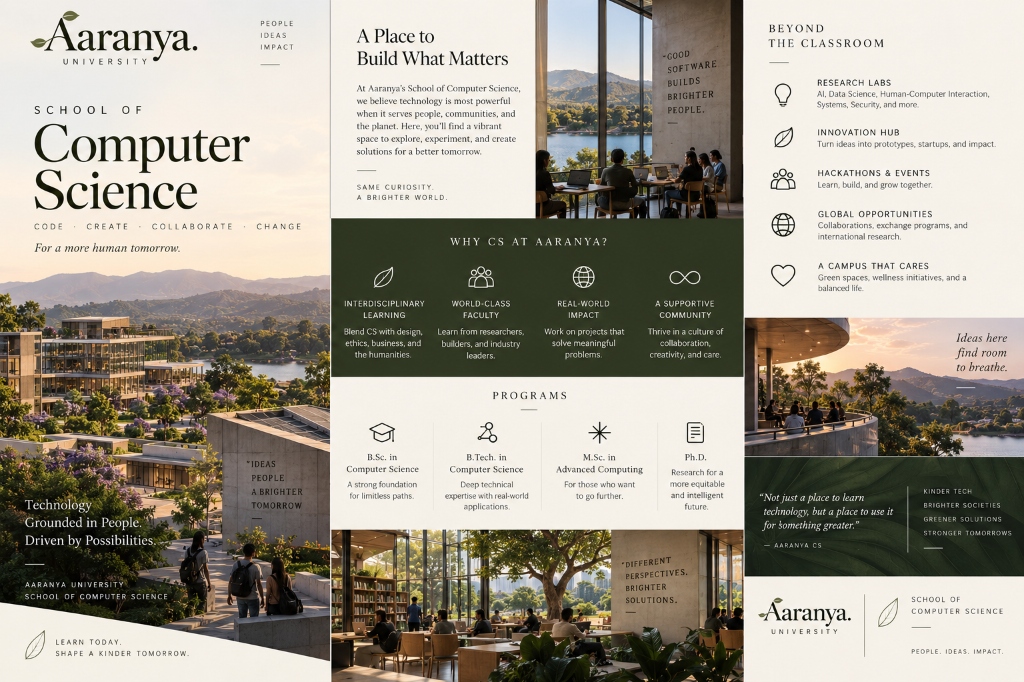
A Place to Build What Matters

Technology Grounded in People. Driven by Possibilities.

At Aaranya's School of Computer Science, we believe technology is most powerful when it serves people, communities, and the planet. Here, you'll find a vibrant space to explore, experiment, and create solutions for a better tomorrow.

“Good software builds brighter people.”

Why CS at Aaranya?

  • Interdisciplinary Learning: Blend CS with design, ethics, business, and the humanities.
  • World-Class Faculty: Learn directly from active researchers, systems architects, and builders.
  • Real-World Impact: Build open solutions that address climate monitoring, assistive healthcare, and civic infrastructure.
  • Supportive Community: An ego-free culture of mentorship, psychological safety, and creative collaboration.
School of Computer Science Official Brochure
Academic Architecture

Comprehensive Curricula by Degree

Inspect the year-by-year academic syllabus, core modules, lab studios, and capstones across our undergraduate, graduate, and doctoral tracks.

B.Tech. in Computer Science

4 Years · 8 Semesters · 160 Academic Credits · Deep Systems & AI Specialization

Engineering Degree

Year 1: Foundations & Computational Thinking Semesters 1 & 2

CS101Introduction to Computing & Python4 Credits
MA101Calculus & Linear Algebra for Engineers4 Credits
PH102Engineering Physics & Quantum Basics4 Credits
CS102Discrete Mathematical Structures4 Credits
EC105Digital Logic & Computer Systems Design4 Credits
CS104Object-Oriented Programming (C++ & Java)4 Credits
HU101Ethics, Technology & Human Values2 Credits
CS191Foundations Programming Studio (Lab)2 Credits

Year 2: Core Systems & Algorithmic Rigor Semesters 3 & 4

CS201Data Structures & Advanced Algorithms4 Credits
CS202Computer Organization & Architecture4 Credits
MA203Probability, Statistics & Random Processes4 Credits
CS204Operating Systems & Kernel Internals4 Credits
CS205Database Management Systems (SQL & NoSQL)4 Credits
CS206Theory of Computation & Automata4 Credits
CS291Systems & OS Implementation Lab2 Credits
CS292Open Source Software Design Practicum2 Credits

Year 3: Distributed Systems & Machine Intelligence Semesters 5 & 6

CS301Computer Networks & Internet Protocols4 Credits
CS302Artificial Intelligence & Heuristic Search4 Credits
CS303Compiler Design & Program Analysis4 Credits
CS304Machine Learning: Principles & Pipelines4 Credits
CS305Cloud Computing & Distributed Microservices4 Credits
CS306Software Engineering & Agile Architectures3 Credits
CS391AI & Machine Learning Studio (Lab)2 Credits
IN301Mandatory Summer Corporate/Research Internship4 Credits

Year 4: Specialization & Senior Capstone Semesters 7 & 8

CS401Cryptography & Distributed Network Security4 Credits
CS402Deep Neural Architectures & Generative Models4 Credits
CS403Human-Computer Interaction (HCI) Design3 Credits
ID401Cross-School Elective (e.g. Technology Law)3 Credits
CS491Senior Capstone Project Phase I (Proposal & Spec)4 Credits
CS492Senior Capstone Project Phase II (Implementation & Defense)6 Credits

Recommended Minors (20–24 Credits)

Minor in Cognitive Science & Philosophy of Mind Offered with Liberal Arts: Neural computation, epistemology, philosophy of consciousness, and semantic models.
Minor in Cyber Law & Digital Ethics Offered with School of Law: Algorithmic regulation, GDPR & data sovereignty, intellectual property in code, and cyber forensic policy.
Minor in Interaction Design & HCI Offered with School of Design: Spatial computing, hardware interaction rigs, UI prototyping, and haptic systems.
Minor in Computational Economics & FinTech Offered with Business School: Algorithmic game theory, financial econometrics, automated market makers, and blockchain.

Departmental Elective Pools (Semesters 5–8)

Intelligent Systems Pool: Natural Language Processing, Reinforcement Learning, Computer Vision, Autonomous Robotics, Generative Audio/Video Models.
Systems & Cloud Architecture Pool: High-Performance Distributed Clusters, Site Reliability Engineering, Microservices Orchestration, Linux Kernel Hacking.
Security & Cryptography Pool: Zero-Knowledge Proofs, Post-Quantum Cryptography, Network Penetration Testing, Binary Exploitation.
Open Interdisciplinary Elective: Any 4 credits selected from Liberal Arts, Law, Business, or Design.

B.Sc. in Computer Science

3 Years · 6 Semesters · 120 Academic Credits · Computational Mathematics & Software Fundamentals

Foundational Science Degree

Year 1: Computational Foundations Semesters 1 & 2

BSC101Programming Foundations with C & Python4 Credits
BSC102Discrete Mathematical Logic4 Credits
BSC103Computer System Fundamentals4 Credits
BSC104Linear Algebra & Vector Calculus4 Credits

Year 2: Data, Systems & Web Architecture Semesters 3 & 4

BSC201Data Structures & Algorithm Design4 Credits
BSC202Relational & Distributed Database Systems4 Credits
BSC203Operating Systems Concepts4 Credits
BSC204Web Technologies & Modern Application Frameworks4 Credits

Year 3: Applied Computation & Capstone Semesters 5 & 6

BSC301Foundations of Artificial Intelligence & Data Science4 Credits
BSC302Network Fundamentals & Cybersecurity4 Credits
BSC303Software Project Management3 Credits
BSC391Undergraduate Research Project & Defense6 Credits

Available Minor Concentrations

Minor in Mathematics & Statistical Modeling: Probability Theory, Numerical Methods, Graph Theory, and Stochastic Processes.
Minor in Digital Humanities: Computational Linguistics, Text Mining in Ancient Literature, and Cultural Analytics.
Minor in Sustainable Technology: Green Data Centers, Electronic Waste Life-Cycles, and Low-Power Edge Computing.

Elective Specialization Modules

Elective Pool A: Full-Stack React & Node Systems, Mobile App Engineering (Flutter/Swift), Modern DevOps Pipelines.
Elective Pool B: Relational Database Optimization, Big Data with PySpark, Cloud Fundamentals (AWS/GCP).
University Elective: Any 1 course from Business Management, Environmental Economics, or Constitutional Law.

M.Sc. in Advanced Computing

2 Years · 4 Semesters · 80 Academic Credits · Advanced Scalable Systems & Machine Learning

Postgraduate Degree

Year 1: Advanced Computing Paradigms Semesters 1 & 2

MSC501Advanced Algorithms & Computational Complexity4 Credits
MSC502Distributed Systems & Consensus Protocols4 Credits
MSC503Deep Learning: Architectures & Optimization4 Credits
MSC504HCI Research Methodologies & Accessibility4 Credits

Year 2: Frontier Specialization & Master's Thesis Semesters 3 & 4

MSC601High-Performance GPU Computing & Parallel Architectures4 Credits
MSC602Applied Cryptography & Privacy-Enhancing Tech4 Credits
MSC691Graduate Research Seminar2 Credits
MSC692Master's Research Thesis & Viva Voce12 Credits

Advanced Specialization Clusters

Cluster 1: Frontier Machine Intelligence Large Foundation Models, Transformer Architectures, Multimodal Learning, and Neuro-Symbolic AI.
Cluster 2: Scalable Distributed Systems Consensus protocols (Paxos/Raft), distributed key-value storage, and fault-tolerant architectures.
Cluster 3: Quantum Computing & Information Quantum Algorithms (Shor/Grover), Quantum Circuit Simulation, and Qubit Hardware Interfaces.

Cross-School Graduate Electives

Law & Ethics Elective: Global AI Governance, Regulatory Frameworks, and Algorithmic Auditing.
Design Elective: Advanced Interaction Prototyping, Spatial Reality & Vision Computing.
Business Elective: Technology Commercialization, Deep-Tech Venture Incubation, and IP Strategy.

Ph.D. in Computer Science

3–5 Years · Doctoral Research Fellowships · Generous Stipends & High-Compute GPU Access

Doctoral Fellowship

Doctoral Progression Stages:

  • Stage 1
    Advanced Doctoral Coursework (Year 1):

    Research Methodologies in Computer Science, Quantitative Empirical Analysis, and Advanced Doctoral Seminar in candidate's specialization (AI/HCI/Systems/Security).

  • Stage 2
    Comprehensive Qualifying Exam & Dissertation Proposal (Year 1.5):

    Oral defense of state-of-the-art literature review and approval of the doctoral research thesis proposal before the Academic Faculty Committee.

  • Stage 3
    Frontier Research, Publication & Defense (Years 2–4):

    Original experimental contribution with requirement of at least two publications in top-tier peer-reviewed conferences (e.g. NeurIPS, ICML, OSDI, SIGCHI, IEEE S&P) followed by final open dissertation defense.

Doctoral Specialization Clusters

Foundation Models & Mechanistic Interpretability Attention circuits, transformer reverse engineering, representation geometry, and alignment verification.
Decentralized Systems & Cryptographic Protocols Zero-knowledge SNARKs, consensus Byzantine fault tolerance, and verifiable decentralized computing.
Autonomous Robotics & Embodied AI Sim-to-real transfer, spatial reinforcement learning, tactile sensing, and multi-robot coordination.
Quantum Computational Architectures Quantum circuits, error mitigation algorithms, quantum advantage proofs, and hybrid quantum-classical algorithms.

Doctoral Research Seminars & Electives

Advanced Topics in Distributed Systems (OSDI/SOSP Reading) Critical dissection of foundational papers, fault injection methodologies, and formal verification with TLA+.
Theoretical Foundations of Deep Learning Overparameterization theory, neural tangent kernels, generalization bounds, and implicit regularization.
Research Ethics, Responsible AI & Policy Dual-use evaluation, copyright in generative synthesis, watermarking, and academic integrity.
Experiential Ecosystem

Beyond the Classroom

Frontier Research Labs

Active discovery in AI & Machine Learning, Data Science, Human-Computer Interaction (HCI), Distributed Operating Systems, and Cryptographic Security.

Innovation Hub

Turn student ideas into prototypes, software products, and venture-funded open source startups with seed incubation.

Hackathons & Events

Learn, build, and grow together through semester hackathons, cybersecurity CTFs, and AI build sprints.

Global Opportunities

International research fellowships, faculty-led overseas research, and student exchange programs with top partner universities.

A Campus That Cares

Green study courtyards, lakeside coding pods, ergonomic workspaces, and student wellness support programs.

The Core Pillars

Kinder Tech · Brighter Societies · Greener Solutions · Stronger Tomorrows.

“Not just a place to learn technology, but a place to use it for something greater.”

Aaranya School of Computer Science · Learn Today. Shape a Kinder Tomorrow.